Books: NCERT Class 4 English Poem (Marigold Unit 8)
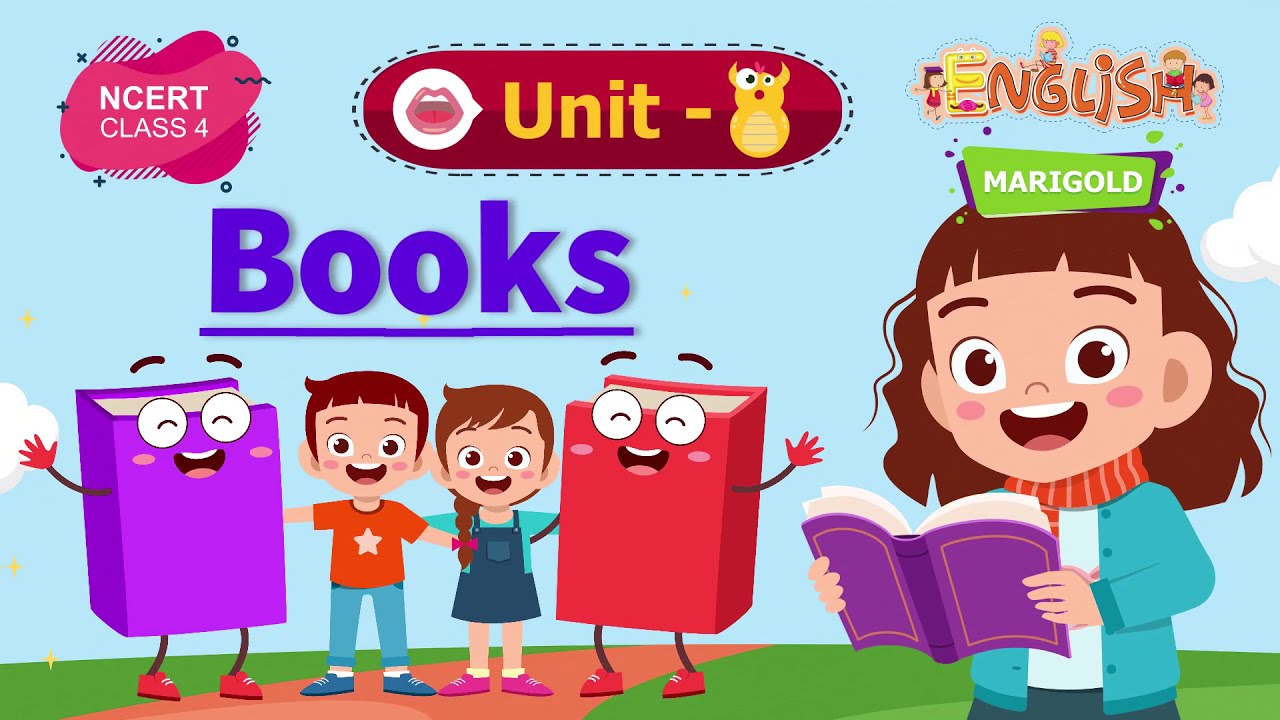
This short, rhyming poem is a gentle invitation to love reading. Children enjoy the picture of a library door that speaks and of books of every shape and size waiting on the shelves.
Open now: the CALP Class 4 English course (Santoor)
Every chapter of Santoor, NCERT’s new book, with notes in English and Hindi, say-it-aloud practice with a score, grammar, speaking and writing practice. ₹1,299 for the whole year, and “Start here” and the first chapter’s notes are free to try.
From the NCERT English book Marigold for Class 4, unit 8. NCERT’s newer Class 4 book is Santoor, but many schools still teach Marigold.
Watch: Books
Play the video three or four times. The first time, just listen. Then point at the pictures, and from the third time, say the lines along with the video. Short, repeated listening is how CALP builds a child’s English.
What your child learns
- Opposite words: tall and short, skinny and fat
- Library words: shelves, books, library
- Rhymes like door and galore, look and book
- Telling a story from pictures
What the poem is about
In the poem, the library door calls the child to come in. The child opens the door wide and sees lots and lots of books. There are tall, skinny books high up on the shelves and little fat books standing by themselves.
The child opens one book and sits down to look at it. The pictures in the book tell stories, and the child thinks it is a wonderful book. The poem shares the joy and excitement of finding new books to read.
New words, with Hindi meanings
- library: a room or building with many books that you can read or borrow (हिंदी: पुस्तकालय)
- galore: in very large numbers, lots and lots (हिंदी: ढेर सारी)
- skinny: very thin (हिंदी: दुबली-पतली)
- shelves: flat boards on a wall or cupboard where things are kept (हिंदी: अलमारी के खाने)
- by themselves: alone, without others (हिंदी: अपने आप, अकेले)
- wonderful: very good and pleasing (हिंदी: शानदार)
- pictures: drawings or photos in a book (हिंदी: चित्र)
Talk about it
Ask these aloud after reading or watching. Let your child answer in English if they can, or mix in their home language. Both help.
- Who says “Come in” to the child in the poem?
- What kinds of books did the child see?
- What told the stories in the book the child opened?
- What is your favourite book? What do you like about it?
Answers for parents
- The library door says “Come in”.
- The child saw tall, skinny books high up on the shelves and little fat books standing by themselves.
- The pictures told the stories.
- For example: My favourite book is a book of animal stories. I like the colourful pictures of the lion and the monkey.
Grammar corner: Opposite words
Opposite words mean the reverse of each other, like tall and short. The poem shows books of different shapes, so it is a good place to learn opposites. Using opposites helps us describe and compare things.
- One book is thick, and the other is thin.
- The big books are up high, and the small books are down low.
- Open the library door when you go in, and close it when you come out.
Practice at home
- Give the opposite: skinny, tall, open.
- Spot the rhyme: Which word in the poem rhymes with ‘book’?
- Fill in the blank: The library had books ___, which means lots and lots of books.
Answers: 1. fat, short, close (or shut) · 2. look · 3. galore
Try this
Make a small home library. Collect all the books in the house and sort them: tall books, short books, thin books and fat books. Let your child pick one book, look only at the pictures and tell you the story they think the pictures show.
Tip for parents
Pick any picture book at home and ask your child to tell you the story in Hindi from the pictures. Then help them say one or two lines in English, like “The cat is on the tree.” Even if you read little English yourself, talking about pictures together builds a love of books, so praise every story they tell.
Questions parents ask
What is the poem Books about?
It is about a child who goes into a library, sees books of all shapes and sizes, and enjoys a book whose pictures tell stories.
Which words rhyme in the poem Books?
‘Door’ rhymes with ‘galore’, ‘shelves’ with ‘themselves’, and ‘look’ with ‘book’.
Which NCERT book has the poem Books?
It is Unit 8 of NCERT's older Marigold book for Class 4. The newer NCERT English books are Mridang for Class 1–2 and Santoor for Class 3–5.
Learn every Class 4 chapter with CALP
Every chapter of Santoor, NCERT’s new book, with notes in English and Hindi, say-it-aloud practice with a score, grammar, speaking and writing practice. ₹1,299 for the whole year.
See the free lessons and enrol →
More from Class 4 English
- A Watering Rhyme (Marigold Unit 7)
- The Donkey (Marigold Unit 7)
- The Naughty Boy (Marigold Unit 9)
- Hiawatha (Marigold Unit 6)
- The Scholar's Mother Tongue (Marigold Unit 6)
- Don't Be Afraid of the Dark (Marigold Unit 5)