Sea Song: NCERT Class 3 English Poem (Marigold Unit 4)
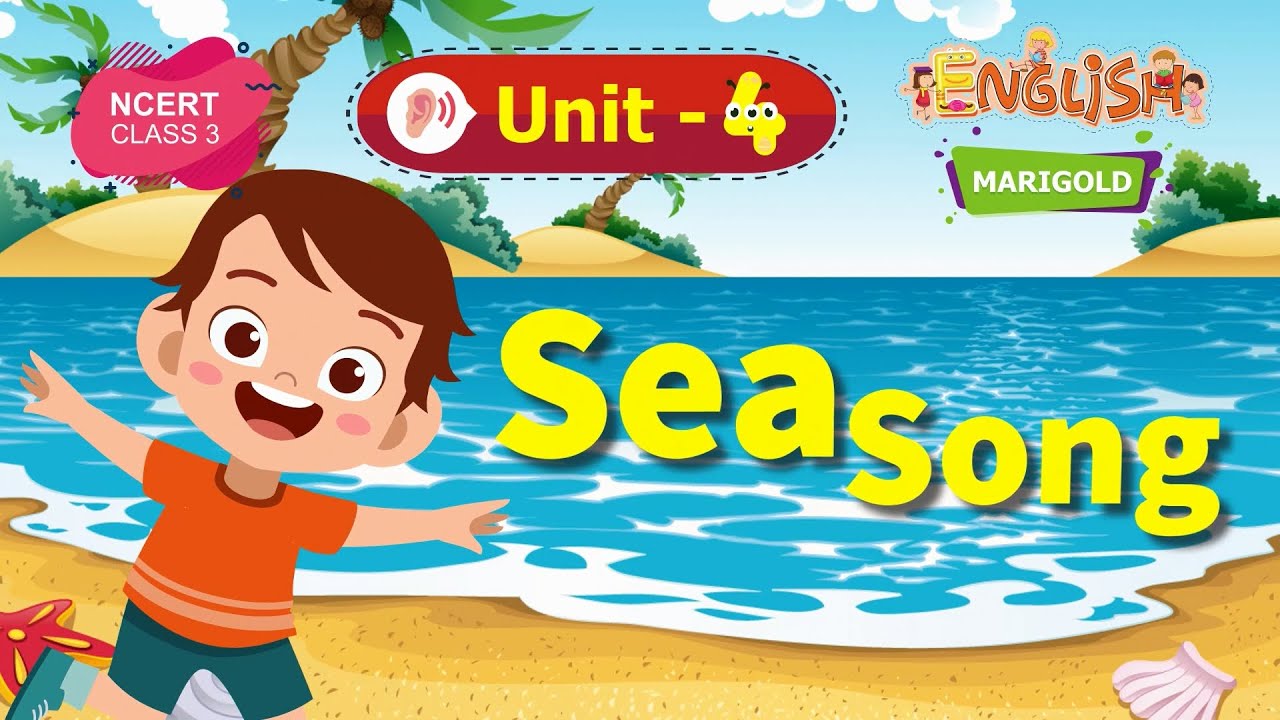
Sea Song captures a small moment of wonder at the beach. Children will love the idea of a shell that sings, and may want to listen to one themselves.
Open now: the CALP Class 3 English course (Santoor)
Every chapter of Santoor, NCERT’s new book, with notes in English and Hindi, say-it-aloud practice with a score, grammar, speaking and first writing practice. ₹1,299 for the whole year, and “Start here” and the first chapter’s notes are free to try.
From the NCERT English book Marigold for Class 3, unit 4. NCERT’s newer Class 3 book is Santoor, but many schools still teach Marigold.
Watch: Sea Song
Play the video three or four times. The first time, just listen. Then point at the pictures, and from the third time, say the lines along with the video. Short, repeated listening is how CALP builds a child’s English.
What your child learns
- Past tense words: found, picked, took, held
- Beach words: shell, sand
- Describing a sound: soft, sweet, clear
- Reading a poem aloud with a feeling of surprise
What the poem is about
A child finds a curly shell lying on the sand, picks it up and carries it home, cold in their hand. Mummy looks at it and holds it to the child's ear.
From inside the shell comes a soft, sweet, clear song. The child is surprised and listens hard, and finds it is really true. The poem ends with the child wishing that the reader could find a big shell and hear it sing too. It is full of surprise and quiet wonder.
New words, with Hindi meanings
- shell: the hard outer covering of a sea animal, often found on a beach (हिंदी: सीप)
- curly: bent round in curves or rings (हिंदी: घुमावदार)
- sand: the tiny grains on a beach (हिंदी: रेत)
- ear: the part of the body we hear with (हिंदी: कान)
- clear: easy to hear (हिंदी: साफ़)
- surprised: feeling something you did not expect (हिंदी: हैरान)
- listened: paid attention to hear something (हिंदी: ध्यान से सुना)
Sing and dance
Once your child knows the poem, sing it together with actions. Children who can’t sing yet can still do the moves.
Talk about it
Ask these aloud after reading or watching. Let your child answer in English if they can, or mix in their home language. Both help.
- Where did the child find the shell?
- Who held the shell to the child's ear?
- What did the child hear inside the shell?
- Have you ever been to a beach? What did you find there?
Answers for parents
- The child found the shell lying on the sand.
- Mummy held the shell to the child's ear.
- The child heard a soft, sweet and clear song.
- For example: Yes, I went to a beach in Goa. I found small white shells and saw big waves.
Grammar corner: Past tense words
We use past tense words for things that already happened. Many add -ed, like look → looked and pick → picked. Some change in a different way, like find → found and take → took.
- I picked up a pink shell at the beach.
- My brother found a tiny crab near the water.
- We took the shell home and listened to it.
Practice at home
- Fill in the blank with the past tense of “find”: I ___ a shell on the sand.
- Choose the past tense: hold → (holded / held); listen → (listened / listen).
- Make a sentence about the beach using the word “shell”.
Answers: 1. found · 2. held; listened · 3. For example: I found a curly shell near the water.
Try this
Hold an empty cup or steel glass over your child's ear and ask them to listen carefully. Talk about the sound they hear. Then ask them to draw a curly shell, colour it, and describe the sound in their own words.
Tip for parents
Ask in Hindi: “सीप में से कैसी आवाज़ आई?” Let your child describe it in Hindi, then find the English words together: soft, sweet, clear. Mixing both languages is fine; praise every new English word they try.
Questions parents ask
What is the poem Sea Song about?
A child finds a curly shell on the sand and takes it home. When Mummy holds it to the child's ear, the child hears a soft, sweet song.
Which words rhyme in Sea Song?
Some rhyming pairs are sand and hand, ear and clear, and true and too.
Which book is Sea Song from?
It is from NCERT's older Marigold book for Class 3 (Unit 4). The newer NCERT English books are Mridang for Class 1–2 and Santoor for Class 3–5.
Learn every Class 3 chapter with CALP
Every chapter of Santoor, NCERT’s new book, with notes in English and Hindi, say-it-aloud practice with a score, grammar, speaking and first writing practice. ₹1,299 for the whole year.
See the free lessons and enrol →
More from Class 3 English
- A Little Fish Story (Marigold Unit 4)
- Little by Little (Marigold Unit 3)
- The Enormous Turnip (Marigold Unit 3)
- The Yellow Butterfly (Marigold Unit 5)
- The Balloon Man (Marigold Unit 5)
- Bird Talk (Marigold Unit 2)