Little Tiger, Big Tiger: NCERT Class 3 English Story (Marigold Unit 7)
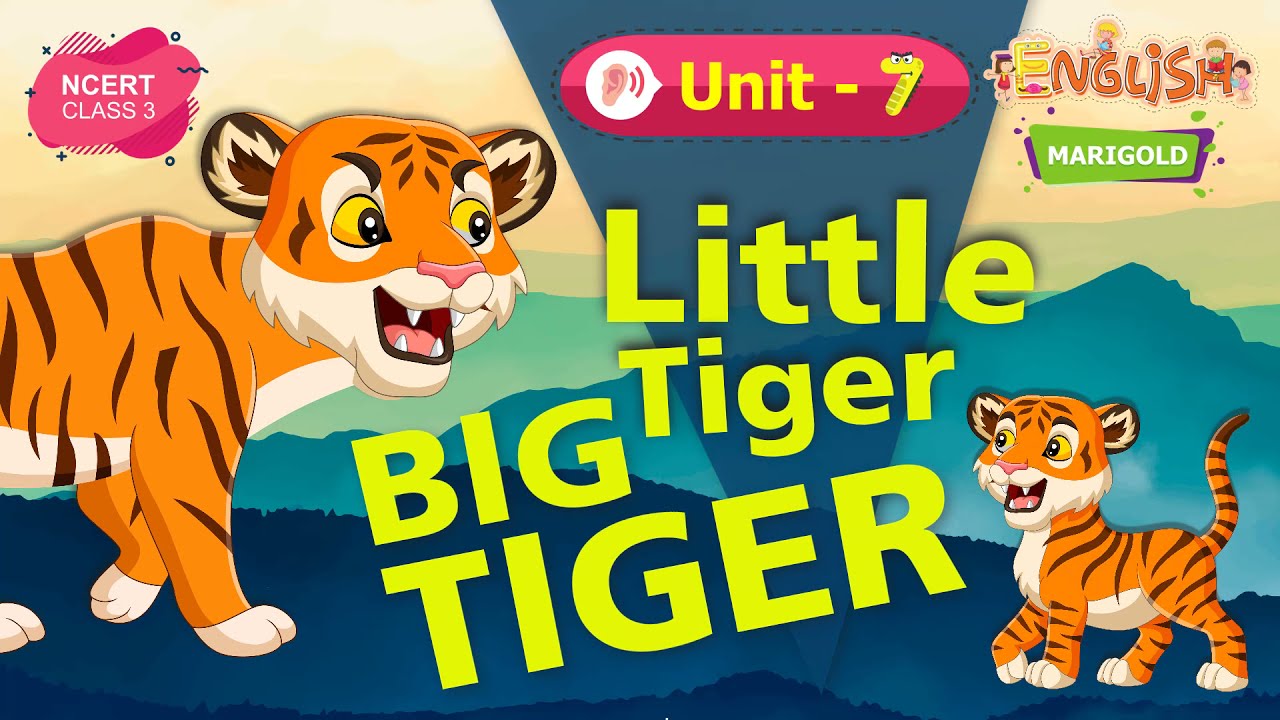
Take your child into a shady jungle with a mother tiger and her playful cub. This story is full of animals and jungle sounds, and it shows, in a warm way, how a little one grows up with a mother's care.
Open now: the CALP Class 3 English course (Santoor)
Every chapter of Santoor, NCERT’s new book, with notes in English and Hindi, say-it-aloud practice with a score, grammar, speaking and first writing practice. ₹1,299 for the whole year, and “Start here” and the first chapter’s notes are free to try.
From the NCERT English book Marigold for Class 3, unit 7. NCERT’s newer Class 3 book is Santoor, but many schools still teach Marigold.
Watch: Little Tiger, Big Tiger
Play the video three or four times. The first time, just listen. Then point at the pictures, and from the third time, say the lines along with the video. Short, repeated listening is how CALP builds a child’s English.
What your child learns
- Jungle animal names: langur, sambar deer, barking deer, jungle fowl
- Opposites: little and big, near and far, loud and quiet
- Action words for movement: pounced, chased, crept
- Talking about growing up and a mother's care
What the story is about
A mother tiger and her small cub live near a river in a shady jungle. At night the mother hunts for deer and pig, and the cub stays close beside her. The langur, the sambar deer and the barking deer call out to warn others that a tiger is coming. On bright moonlit nights she rests, and the cub plays by pouncing on the tip of her tail. One night, while his mother sleeps, the cub chases a little frog. When he turns, his mother is out of sight and a bigger tiger with green eyes is creeping towards him. Then the mother tiger roars, faces the other tiger, and it goes away.
When the mother roars, all the jungle animals keep far away. When the cub roars, nobody is afraid. But years pass, and the cub becomes a full-grown tiger who hunts alone. Now, when he roars, all the animals keep far away, and the big tiger smiles to himself.
New words, with Hindi meanings
- shady: cool and dark because trees block the sun (हिंदी: छायादार)
- cub: a baby tiger, lion or bear (हिंदी: शावक)
- dawn: the time early in the morning when the sky gets light (हिंदी: भोर / सुबह)
- twitched: moved a little, quickly (हिंदी: फड़काया / हिलाया)
- pounced: jumped suddenly to catch something (हिंदी: झपटा)
- glistened: shone brightly (हिंदी: चमकीं)
- frightened: afraid; scared (हिंदी: डरा हुआ)
- crept: moved slowly and quietly so as not to be noticed (हिंदी: दबे पाँव आया)
Talk about it
Ask these aloud after reading or watching. Let your child answer in English if they can, or mix in their home language. Both help.
- Where did the mother tiger and her cub live?
- What did the cub chase on the night his mother was tired?
- How did the mother tiger save her cub from the bigger tiger?
- What could you not do when you were small that you can do now?
Answers for parents
- They lived near a river in a shady jungle.
- He chased a tiny frog.
- She gave a loud roar and faced the other tiger, and he went away.
- For example: When I was small I could not ride a cycle. Now I can ride it on my own.
Grammar corner: Opposites
Opposites are pairs of words with very different meanings, like little and big. The title itself is a pair of opposites. The story also shows near and far, and loud and quiet.
- The cub was little, but his mother was big.
- The cub stayed near his mother, and the deer ran far away.
- The mother gave a quiet grunt and then a loud roar.
Practice at home
- Write the opposite: little → ___, near → ___
- Fill in the blank: The cub ___ on his mother's tail. (pounced / slept)
- Make a sentence with 'frightened'.
Answers: 1. big, far · 2. pounced · 3. For example: The cub was frightened when he saw the big tiger.
Try this
Have a roar game. First, everyone gives a tiny cub roar and nobody runs away. Then everyone stands tall and gives a big tiger roar, and the others pretend to hide. You can also play 'tail chase': one person wiggles a scarf or dupatta behind them like the mother tiger's tail, and the little 'cub' tries to pounce on it.
Tip for parents
Tell the story in Hindi first, with words like 'शावक', 'दहाड़' and 'जंगल', so your child knows what happens. Then read it in English and stop at words like 'pounced' and 'crept' to act them out. Let your child retell it in a mix of Hindi and English, and praise every English word.
Questions parents ask
What is the story Little Tiger, Big Tiger about?
A tiger cub lives with his mother in the jungle. She keeps him safe, even from a bigger tiger. Years later the cub grows into a big tiger whose roar makes every animal keep away.
Who are the characters in Little Tiger, Big Tiger?
The mother tiger, her tiger cub and a bigger tiger, along with jungle animals like the langur, the sambar deer, the barking deer and a little frog.
Which book is Little Tiger, Big Tiger from?
It is from NCERT's older Marigold book for Class 3 (Unit 7). The newer NCERT books are Mridang for Class 1–2 and Santoor for Class 3–5.
Learn every Class 3 chapter with CALP
Every chapter of Santoor, NCERT’s new book, with notes in English and Hindi, say-it-aloud practice with a score, grammar, speaking and first writing practice. ₹1,299 for the whole year.
See the free lessons and enrol →
More from Class 3 English
- Puppy and I (Marigold Unit 7)
- The Story of the Road (Marigold Unit 6)
- Trains (Marigold Unit 6)
- My Silly Sister (Marigold Unit 8)
- What's in the Mailbox (Marigold Unit 8)
- The Yellow Butterfly (Marigold Unit 5)