My Silly Sister: NCERT Class 3 English Story (Marigold Unit 8)
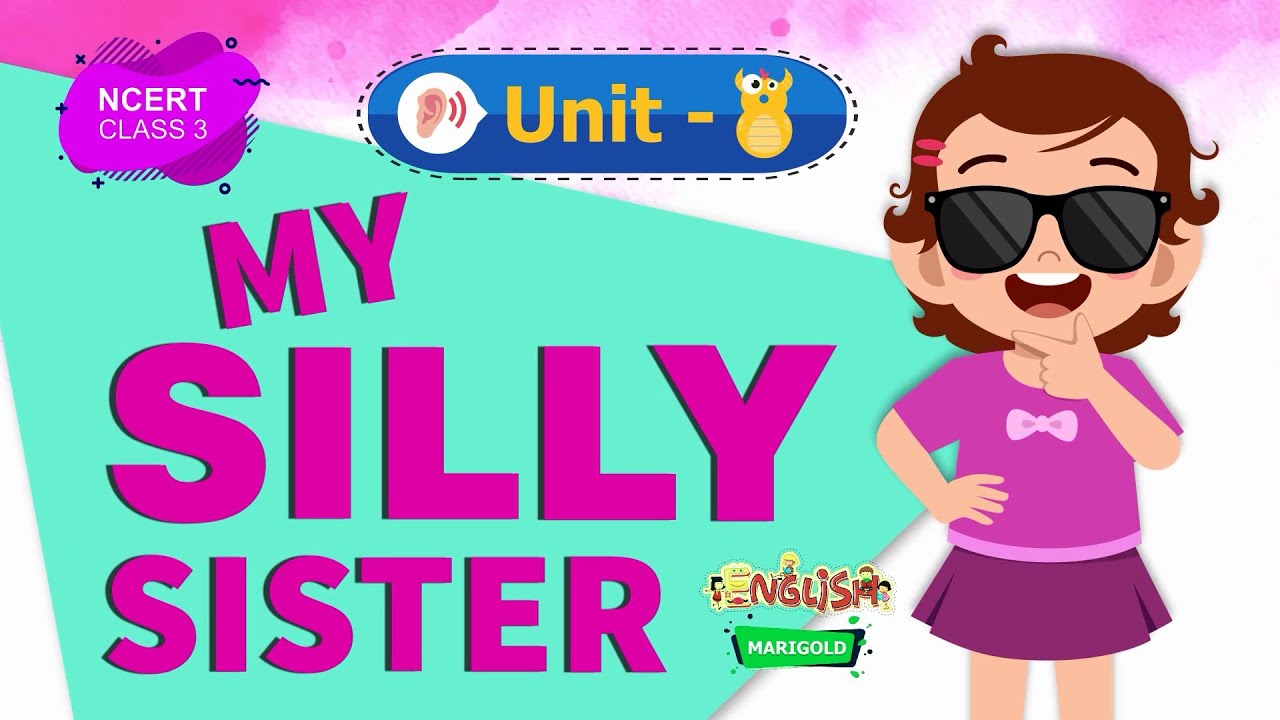
Any child with a baby brother or sister will smile at this chapter. An older child complains to Mother about the baby, but the words are full of love, and children enjoy spotting how the older child is also being a little childish.
Open now: the CALP Class 3 English course (Santoor)
Every chapter of Santoor, NCERT’s new book, with notes in English and Hindi, say-it-aloud practice with a score, grammar, speaking and first writing practice. ₹1,299 for the whole year, and “Start here” and the first chapter’s notes are free to try.
From the NCERT English book Marigold for Class 3, unit 8. NCERT’s newer Class 3 book is Santoor, but many schools still teach Marigold.
Watch: My Silly Sister
Play the video three or four times. The first time, just listen. Then point at the pictures, and from the third time, say the lines along with the video. Short, repeated listening is how CALP builds a child’s English.
What your child learns
- Action words with ‘she’: she thinks, she laughs, she tears
- Words for behaviour: silly, childish, naughty
- Seeing the love behind a complaint
- Talking about babies and how we grow
What the story is about
An older child speaks to Mother about the baby sister and says she is very silly and childish. The baby cannot tell the difference between street lights and bright stars. When they play with pebbles, she thinks the pebbles are real food and tries to put them in her mouth. When the older child opens a book to teach her the alphabet, she tears the pages and laughs with joy.
If the older child scolds her or calls her naughty, she only laughs and thinks it is great fun. Father is away, but when the older child playfully calls out “Father”, the baby looks around excitedly. The older child plays school with the washerman’s donkeys as the class, and warns the baby to keep quiet. The baby even wants to catch the moon. The child ends by telling Mother again that the baby is silly.
New words, with Hindi meanings
- silly: not sensible, in a funny way (हिंदी: बुद्धू, नासमझ)
- childish: behaving like a very small child (हिंदी: बचकाना)
- difference: the way two things are not the same (हिंदी: फ़र्क)
- pebbles: small, smooth stones (हिंदी: कंकड़)
- scold: to speak angrily to someone who has done wrong (हिंदी: डाँटना)
- naughty: badly behaved, doing things you should not do (हिंदी: शरारती)
- washerman: a man who washes clothes for other people (हिंदी: धोबी)
- schoolmaster: a man who teaches in a school (हिंदी: मास्टर जी)
Talk about it
Ask these aloud after reading or watching. Let your child answer in English if they can, or mix in their home language. Both help.
- What does the baby think the pebbles are?
- What does the baby do when the book is opened in front of her?
- Who are the pupils when the older child plays school?
- Do you know a small baby? What funny things does the baby do?
Answers for parents
- She thinks the pebbles are real food, and tries to put them in her mouth.
- She tears the pages with her hands and laughs with joy.
- The washerman’s donkeys are the pupils.
- For example: My cousin is a baby. He puts everything in his mouth and laughs when I make funny faces.
Grammar corner: Action words with ‘she’ and ‘he’ (adding -s)
When we talk about one person, like ‘she’ or ‘he’, in the present, we add -s to the action word. We say ‘I laugh’ but ‘she laughs’. This chapter uses this a lot when it tells what the baby does.
- The baby claps when she sees the moon.
- She crawls to the door and looks for Father.
- My sister drinks milk from a little cup.
Practice at home
- Fill in the blank: She ___ (think) the pebbles are food.
- Choose the right word: The baby (laugh / laughs) when I scold her.
- Make a sentence about a baby using ‘naughty’.
Answers: 1. thinks · 2. laughs · 3. For example: The naughty baby pulled the cat's tail.
Try this
Play “teacher and baby”. One child is the teacher and the other is the baby. The teacher tries to teach the ABC while the baby giggles, looks around and reaches for the moon. Then swap roles. Afterwards, ask your child to name two things they could not do as a baby but can do now.
Tip for parents
Tell your child a funny story in Hindi about what they did as a baby: “तुम छोटे थे तो कंकड़ मुँह में डाल लेते थे।” Then help them say it in English with ‘I’: “I put pebbles in my mouth.” Let them mix words if needed, and praise every sentence they try.
Questions parents ask
Who are the characters in My Silly Sister?
The chapter has an older child who is speaking, the baby sister, and Mother, who is being spoken to. Father is mentioned but is away, and the washerman’s donkeys appear in the pretend school.
What is My Silly Sister about?
An older child tells Mother all the funny things the baby does, like thinking pebbles are food and wanting to catch the moon. The child calls her silly, but the words show love for her.
Which NCERT book has My Silly Sister?
It is Unit 8 of NCERT's older Marigold book for Class 3. The newer NCERT English books are Mridang for Class 1–2 and Santoor for Class 3–5.
Learn every Class 3 chapter with CALP
Every chapter of Santoor, NCERT’s new book, with notes in English and Hindi, say-it-aloud practice with a score, grammar, speaking and first writing practice. ₹1,299 for the whole year.
See the free lessons and enrol →
More from Class 3 English
- What's in the Mailbox (Marigold Unit 8)
- Little Tiger, Big Tiger (Marigold Unit 7)
- Puppy and I (Marigold Unit 7)
- Don't Tell (Marigold Unit 9)
- The Story of the Road (Marigold Unit 6)
- Trains (Marigold Unit 6)